If we wanted to avoid all traces of alcohol, would we also have to stop consuming all foods that naturally contain alcohol?
Many people think that avoiding alcohol means choosing only products labeled 0.0%. However, alcohol isn’t found only in wine, beer, and spirits. It occurs naturally in many foods we consume daily, such as bananas, bread, fruit juices, yogurt, vinegar, ketchup, and soy sauce.
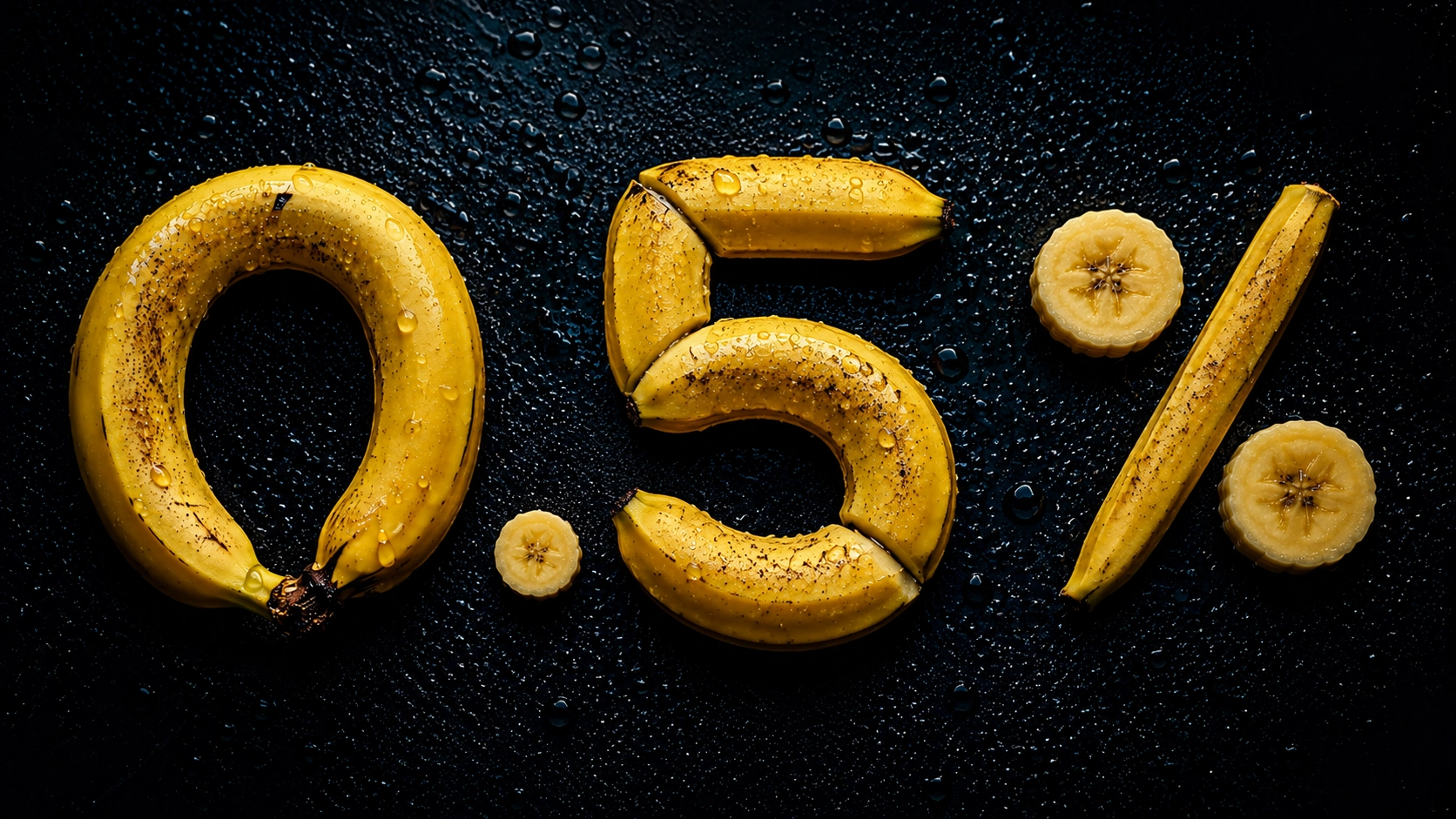
A ripe banana may contain about 0.2% alcohol, and in a very ripe banana, the concentration can rise to about 0.4%. This falls within the same alcohol content range as many wines containing up to 0.5% alcohol.
"Up to 0.5%" does not mean that the wine contains exactly 0.5% alcohol. It is an upper limit. Wines in this category typically contain about 0.1–0.3% alcohol today.
A difference between 0.0% and 0.5% could therefore literally correspond to the alcohol content naturally found in a ripe banana.
There's already alcohol on our plates
Foods produced through fermentation may naturally contain alcohol.
Studies have reported, among other things, the following alcohol concentrations:
- Ripe and very ripe bananas: about 0.2–0.4%
- Breads, such as sourdough bread, hamburger buns, and rye bread: approximately 1.18–1.28%, and in some cases as high as 1.9%
- Fruits and fruit juices: approximately 0.04–0.5%
- Yogurt, buttermilk, and kefir: about 0.05–2%
- Kombucha and grape juice: about 0.5–5%
- Acids: approximately 0.1–0.4%
- Mustard, ketchup, soy sauce, and other condiments: about 1.5–2%
- Certain soft drinks: up to 0.5%
- Extracts and flavorings (e.g., beverages and baked goods): up to 35%
The alcohol content may vary depending on the raw materials, production method, storage conditions, temperature, and fermentation time.
Avoiding all alcohol is therefore not as simple as just cutting out regular alcoholic beverages.
What does "up to 0.5%" mean in wine?
Wine labeled as containing no more than 0.5% alcohol may contain any amount of alcohol below this limit. The label does not mean that every bottle contains exactly 0.5% alcohol.
Wines in this category currently contain, in practice, about 0.1–0.3% alcohol. The wines are vinified—or, more commonly, fermented—into wine first, after which the alcohol is removed. Only a very small amount of residual alcohol remains.
– Without the vinification process, the product cannot be called “wine.”
Regular wine typically contains about 10–14% alcohol. Wine with an alcohol content of 0.1–0.3% therefore contains only a fraction of the alcohol found in regular wine.
Alcohol content and the total amount of alcohol consumed are, of course, two different things. In this case, however, the serving size also makes the comparison surprisingly accurate.
The edible part of a banana typically weighs about 100–120 grams. If a very ripe banana contains the maximum amount reported in the study—0.4 grams of alcohol per 100 grams—a single banana may contain about 0.40–0.48 grams of alcohol.
A 120-milliliter glass of wine containing exactly 0.5% alcohol contains approximately 0.47 grams of alcohol.
Based on these maximum values, the total amounts of alcohol in a banana and a glass of wine can therefore be nearly the same.
The comparison shows that the alcohol content of wines containing no more than 0.5% alcohol is by no means exceptional when compared to ordinary foods.
Why is there alcohol in food?
Alcohol can form naturally when yeast or bacteria break down sugars.
This happens, for example, when:
- the fruit ripens
- the bread dough is rising
- Milk is fermented to make yogurt or kefir
- The tea is fermented into kombucha
- Vinegar is made from grapes or other fruits
- Soybeans and grains are fermented to make soy sauce
Alcohol is also used as a solvent or carrier in extracts, flavorings, colorings, and other food ingredients.
In fact, scientific research has shown that alcohol is present in food both as an additive and as a natural byproduct of fermentation.
Bread may contain more alcohol than non-alcoholic wine
Yeast uses the sugars in bread dough and, in the process, produces carbon dioxide and alcohol. The carbon dioxide causes the dough to rise, and some of the alcohol may remain in the finished bread even after baking.
Studies have measured alcohol concentrations of approximately 1.18–1.28% in items such as hamburger buns and rye bread. The concentration in some types of bread can be as high as 1.9%.
This is significantly higher than the maximum alcohol content allowed for wine containing no more than 0.5% alcohol.
Of course, eating bread is not the same as drinking an alcoholic beverage. The serving size and total amount of alcohol are different. However, the figures show just how common the presence of alcohol in food is. It is not unusual for breath tests conducted on people after they have eaten fresh sourdough bread to reveal low levels of alcohol.
Fruits, juices, and fermented dairy products
As a fruit ripens, its sugars may begin to ferment. For this reason, a ripe banana may contain about 0.2% alcohol, and a very ripe banana about 0.4%.
Fruit juices may contain approximately 0.04–0.5% alcohol. The alcohol content may increase during storage as fermentation continues.
Yogurt, buttermilk, and kefir may contain approximately 0.05–2% alcohol, depending on the microorganisms used and the fermentation time.
Juice, yogurt, or kefir may therefore contain the same amount of alcohol—or even more—than wine with an alcohol content of up to 0.5%.
Vinegar, ketchup, and other condiments
Vinegar is produced through fermentation. First, yeast converts sugars into alcohol, after which bacteria convert most of the alcohol into acetic acid. However, a small amount of alcohol may still remain in the final product.
Balsamic, champagne, sherry, wine, and apple cider vinegars may contain about 0.1–0.4% alcohol.
Mustard, soy sauce, and even ketchup may also contain small amounts of alcohol.
All products containing vinegar can therefore cause a so-called Antabuse reaction in people taking medications that react with alcohol.
This shows that alcohol is the same substance regardless of whether it comes from wine or ordinary food.
Soft drinks and flavorings may also contain alcohol
Some soft drinks may contain up to 0.5% alcohol.
Alcohol may form in a beverage as a result of the fermentation of sugars. It may also end up in the product from flavorings in which alcohol is used as a carrier.
Vanilla, almond, and other flavor extracts may contain significantly higher concentrations of alcohol—in some cases, as much as 35%.
Although cooking reduces the amount of alcohol, it does not necessarily eliminate it immediately or completely.
Alcohol is the same regardless of its source
The alcohol discussed in this blog is ethanol.
The alcohol produced during the fermentation of grapes is chemically the same as the alcohol formed during the fermentation of bananas, bread, juice, yogurt, or vinegar.
Although the concentration and dose size may vary, the molecule itself does not change.
If we wanted to avoid any traces of alcohol, would we have to stop consuming all foods that contain alcohol?
Should we avoid ripe bananas, rye bread, yogurt, fruit juice, vinegar, ketchup, soy sauce, kombucha, vanilla extract, and certain soft drinks?
There may be valid personal, health-related, cultural, or religious reasons for choosing 0.0% products. Clear labeling is essential so that everyone can make an informed choice.
Isn't it time to view non-alcoholic wines containing up to 0.5% alcohol in the same way as the small amounts of alcohol that occur naturally in many common foods?
Does culture have a greater influence on our attitudes than science?
Avoiding alcoholic beverages is simple. Avoiding every trace of alcohol is an entirely different matter. That would require us to reevaluate a large portion of the foods already on our plates.
A "zero-tolerance " policy may not, in the end, be as "necessary"—or even feasible—for everyone as many of us think.
– Moderation in all things, even with zero.
Sources
Herdiana, Y. (2025). Alcohol in Everyday Products: Health Risks, Cultural Considerations, and Economic Impacts. Risk Management and Healthcare Policy, 18, 217–237. DOI: 10.2147/RMHP.S495493.
Vinegar-Induced Disulfiram Reaction. The Primary Care Companion for CNS Disorders.